
Why laser tools are better for belt alignment
Do you still use straight edge or string to align your belt transmissions? There is a better and easier method available, which quickly pays for itself.
Published: March 17, 2017

It is a common misconception that it doesn’t matter whether you align your sheave/pulleys or not. That is probably why aligning pulleys using a straight edge is still common. But belts also have tolerances to meet. Using old alignment methods then, just won’t do.
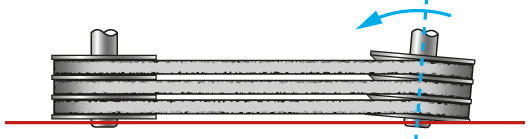
Most laser-based belt alignment tools are based on a “laser plane” that is parallel with one pulley and that constitutes the reference with which the other pulley is aligned. In fact, you could say that the laser beam is an absolutely straight, weightless
Tool for simple alignment
Some belt manufacturers still challenge their customers to use a ruler when aligning. This is despite the fact that there has long been a simpler solution, namely using a laser. Using the Easy-Laser D92 BTA and its integrated magnets, it is easy to secure the laser transmitter to the side of the pulley and visually check the alignment of the targets, which are located on the other pulley. You are not restricted by the length or weight of a ruler or steel rule. It is possible to discern approximately 0.5 mm (20 mils) with the naked eye, and this is often sufficiently accurate and satisfies the specifications for the machine. But it is absolutely not optimal!
Most modern pulleys are machined, which is why securing to the side is not a problem. The side of the pulley will also never be worn by the belt, which can happen with the belt groove. The side mounting also makes it possible to align pulleys that do not have a groove, such as toothed belts, flat belts and chain drives, using the same laser tool. And the Easy-Laser D92 is so light and handy that it can also be secured to a non-magnetic surface with double-sided tape.
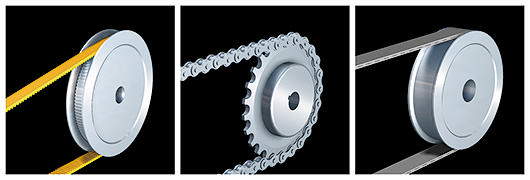
A side-mounted laser tool can also be used to align pulleys without a belt groove.
Another advantage of laser tools is that you can easily see any misalignment of the pulleys both horizontally and vertically at the same time. Using a ruler to check the vertical parallelism of two pulleys is very time-consuming. (The sheave/pulley can naturally also be installed with the pulleys horizontal, yet the procedure for alignment is still the same.) In fact, because alignment is so much quicker with a laser tool, you will have less downtime. This in itself is a reason for using it.
To make things even easier and more accurate, you should use the Easy-Laser XT190 BTA. The alignment is presented digitally “live” on the detector and, if you choose to use one, a separate display unit running the XT Alignment app. The machine's shim and adjustment values are automatically calculated. As this is a wireless system and all the values are shown “live”, you can take the display unit with you to the adjustment point on the machine. This makes your work much easier! The results of the alignment can also be documented in the form of a report, which would not be the case if you had used an analogue tool.
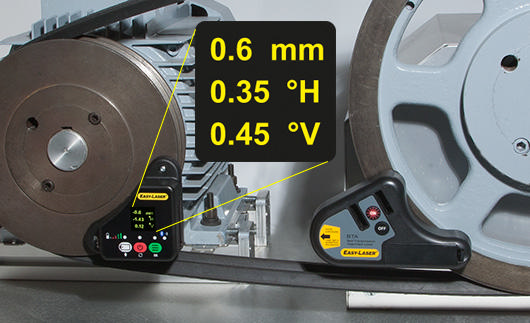
Using a digital tool you can align to the belt manufacturer’s tolerance, and you can also document the result. Offset in mm or inches, horizontal and vertical angle “live” at the same time.
What are the main benefits of using lasers?
- Your results are more reliable and are less affected by the human factor. This is particularly true with a digital tool, which is not affected by the individual engineer’s eyesight.
- You can document the results and show that they satisfy the machine manufacturer’s specifications and your company’s applicable standards according to ISO. A form of quality assurance.
- It is simple, as well as being faster and more efficient than traditional methods. In other words, there is a greater chance of alignment being performed properly when replacing belts.
- If required, the alignment can be performed by just one person.
- An inexpensive investment that quickly pays for itself, in part through reduced energy consumption.
Here are some examples of how much you can save, having your belt drives correctly aligned
Read part 1 in this series: Do you have hidden opportunities to make savings?
Talk to our experts about how we can help you today
Whether you have a specific application in mind or need guidance, our experts can help you choose the right approach and equipment.
Straightforward advice, aligned with your needs, your operation, and your budget.
Subscribe to our newsletter
Practical alignment knowledge, real industry applications, and product updates – delivered straight to your inbox.